
NEET Protest Case: Supreme Court Rejects Panel Reconstitution | Supreme Court Rejects Request to Change NEET Protest Panel
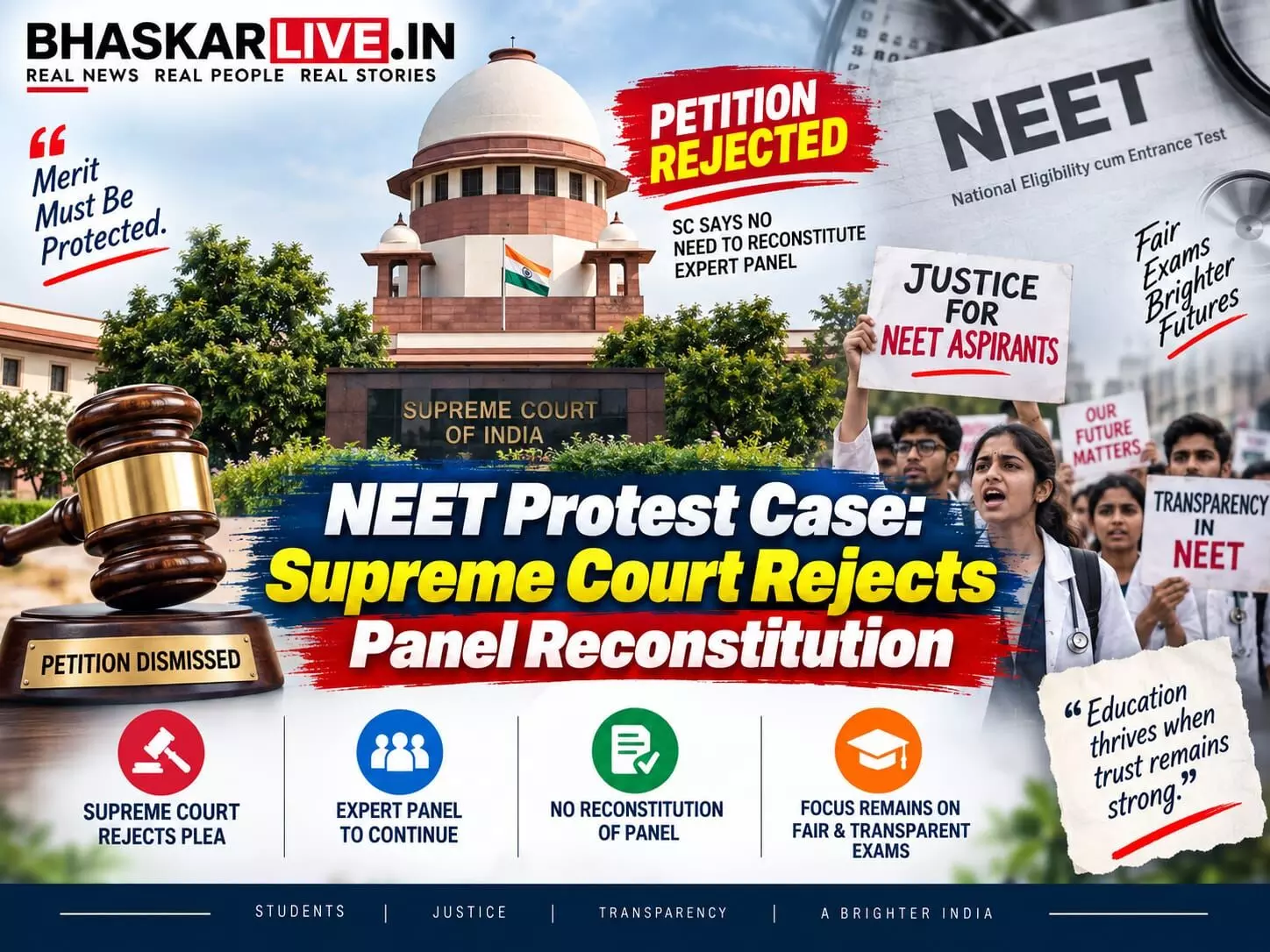
DIGITAL DESK | The Supreme Court of India on September 10, 2026, refused to reconstitute its five-member High-Powered Enquiry Committee (HPEC) set up to examine allegations arising from recent student protests linked to NEET.
A bench comprising Chief Justice of India Surya Kant and Justices Joymalya Bagchi and V. Mohana said it would not proceed on the assumption that the committee was biased. The Court said the panel would work under its supervision and that concerns about its functioning could be brought before the Court.
Why Did Petitioners Seek Reconstitution?
During the hearing, advocate Prashant Bhushan, appearing for one of the petitioners, raised concerns about a possible conflict of interest involving L.R. Bishnoi, a retired Meghalaya Director General of Police and one of the committee members.
The petitioners argued that Bishnoi's reported association with a senior person who could potentially come under the committee's investigation raised questions about the panel's independence.
The Court, however, declined to replace or reconstitute the committee. Chief Justice Surya Kant said the committee was an extension of the Court and would remain under its supervision.
Who Is on the High-Powered Committee?
The five-member committee is headed by former Supreme Court judge Justice R. Subhash Reddy.
The other members include:
Former Punjab and Haryana High Court Chief Justice Ravi Shankar Jha
Former Delhi High Court judge Justice Shalinder Kaur
Former CBI director Rishi Kumar Shukla
Retired Meghalaya DGP L.R. Bishnoi
The committee was constituted by the Supreme Court to examine allegations concerning police action during the protests as well as alleged violence against police personnel.
What Will the Committee Investigate?
The inquiry concerns allegations of excessive or disproportionate police force against student protesters. The broader investigation also covers allegations of violence by protesters against police personnel.
The committee is expected to examine the circumstances surrounding the protests and the conduct of both protesters and law-enforcement authorities.
Importantly, these issues are under investigation. The formation of the committee does not mean that allegations against police or protesters have already been legally established.
Supreme Court to Supervise Inquiry
The Supreme Court made clear that it will continue to supervise the committee's work.
Chief Justice Surya Kant said that if anyone believes the committee has gone wrong, the matter can be brought before the Court and an open hearing can be provided.
This means the Court has chosen to retain the existing panel rather than start the inquiry again with a new composition.
Fact Check
Verdict: The main report is accurate.
The Supreme Court did refuse to reconstitute the five-member committee on September 10. The Court also confirmed that the panel would operate under its supervision.
However, the alleged conflict of interest involving L.R. Bishnoi has not been established as a fact by the Court. It was a concern raised by the petitioners.
Similarly, allegations of police excesses or violence during the protests should not be described as proven wrongdoing until the committee completes its examination and the Court considers its findings.